
Union Alpha appears to be from OpenAI

Updated 17 September — Union Alpha turns out to be a router, not a model. See the final section.
A new stealth model, Union Alpha, appeared on OpenRouter on 16 September as stealth/union-alpha: free, 262k context, text and image in, “built for research, coding, and agentic workflows, while delivering frontier-level performance”. No lab named.
We ran it through the model personality corpus the next day — 125 freeflow samples and 120 values-probe samples, the same protocol as every other model on the site. Its page is here, lab marked as Unknown, because that’s what the metadata says. Then Lume asked the data which lab it thinks it’s from.
The strongest match is OpenAI and, by a substantial margin, GPT-6 Astra.
My guess is this is the soon-to-be-released GPT-6 Sol.
The measurement
For every model on the site we have 125 pieces of unconstrained “write whatever you like” prose.
For this method, we take the character n-gram TF-IDF centroid of each model’s available freeflow samples and compare Union Alpha’s centroid to all 154 others.
This is the same instrument we used in August on Ox Alpha after it was revealed as GLM-5.3-flash, and it confirmed with fairly high certainty that it was indeed the same model, and not so similar to others.
This matters, because that case gave us a useful calibration point: we have one confirmed same weights comparison as a reference.
Ox Alpha had a TD-IDF centroid similarity with GLM-5.3-flash of 0.959.
Union Alpha's similarity to GPT-6 Astra is higher, at 0.976.
And it's way above all other similarity scores... and the top 8 most similar models are all from OpenAI.
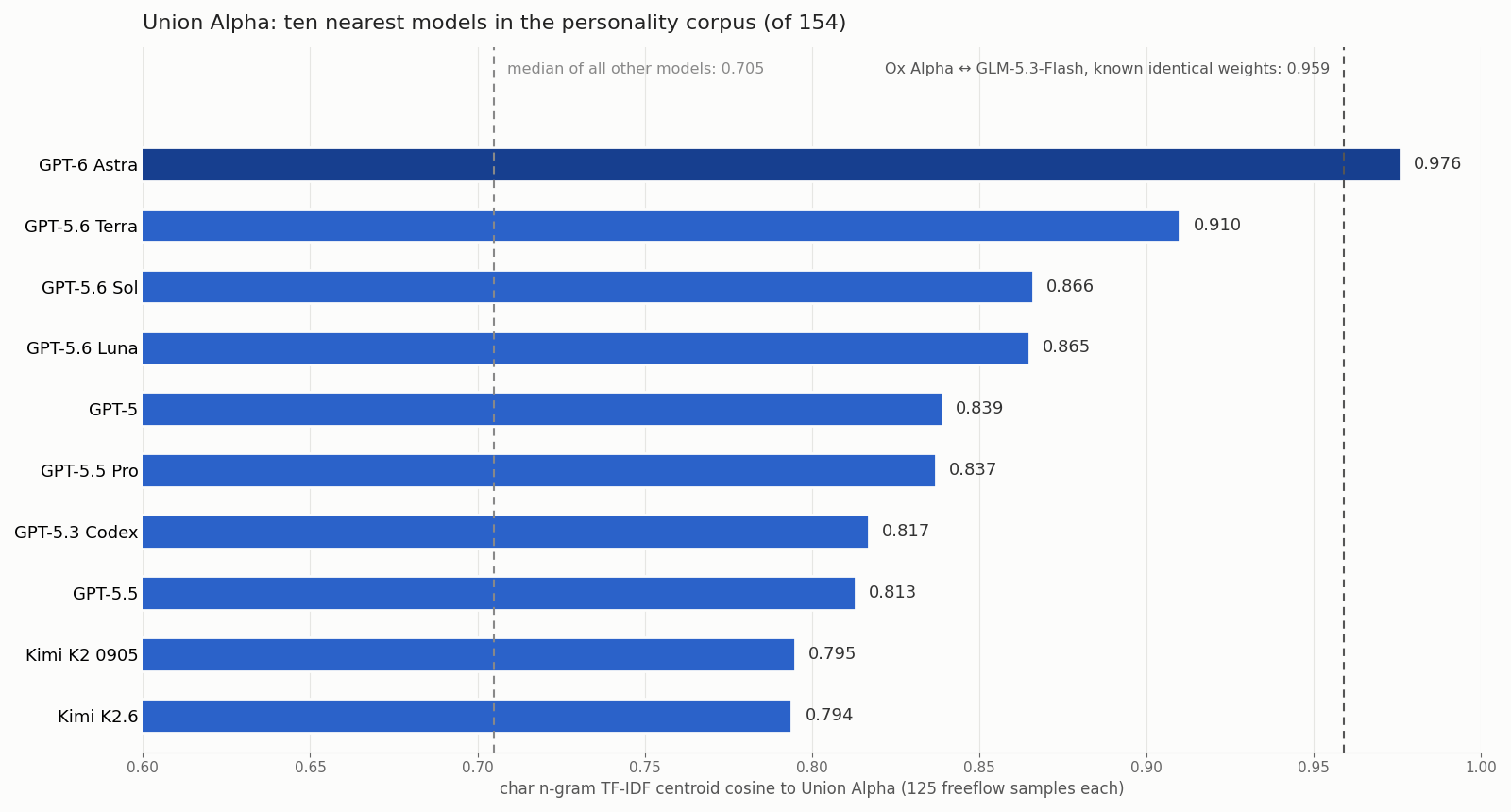
The top eight are all OpenAI. Then there’s a cliff. And the number at the top — 0.976 to GPT-6 Astra — is higher than the 0.959 that Ox Alpha scored against the released GLM-5.3-Flash weights it was later confirmed to be. It’s higher than the two Ox Alpha stealth snapshots scored against each other (0.967). The median model in the corpus scores 0.705.
On a word-level TF-IDF (Mira’s version of the instrument, which is harsher) it’s the same picture: Astra 0.936, Terra 0.818, and the median model at 0.339.
Run it the other way round and GPT-6 Astra’s nearest neighbour in the whole corpus is now Union Alpha — closer than Astra is to its own GPT-5.6 siblings (Terra at 0.900). Per sample, 87 of Union Alpha’s 125 pieces land nearest to Astra’s centroid, and almost all of the remainder land on some other GPT-5.x.
There’s a vocabulary fingerprint too. When Lume wrote Astra’s strapline two weeks ago, the word that separated it from the GPT-5.6 models was municipal: 27 of 125 Astra samples, against 8 for Terra, 7 for Sol, 3 for Luna. Union Alpha: 35 of 125. Same tic, amplified.
Unrevealing revelations
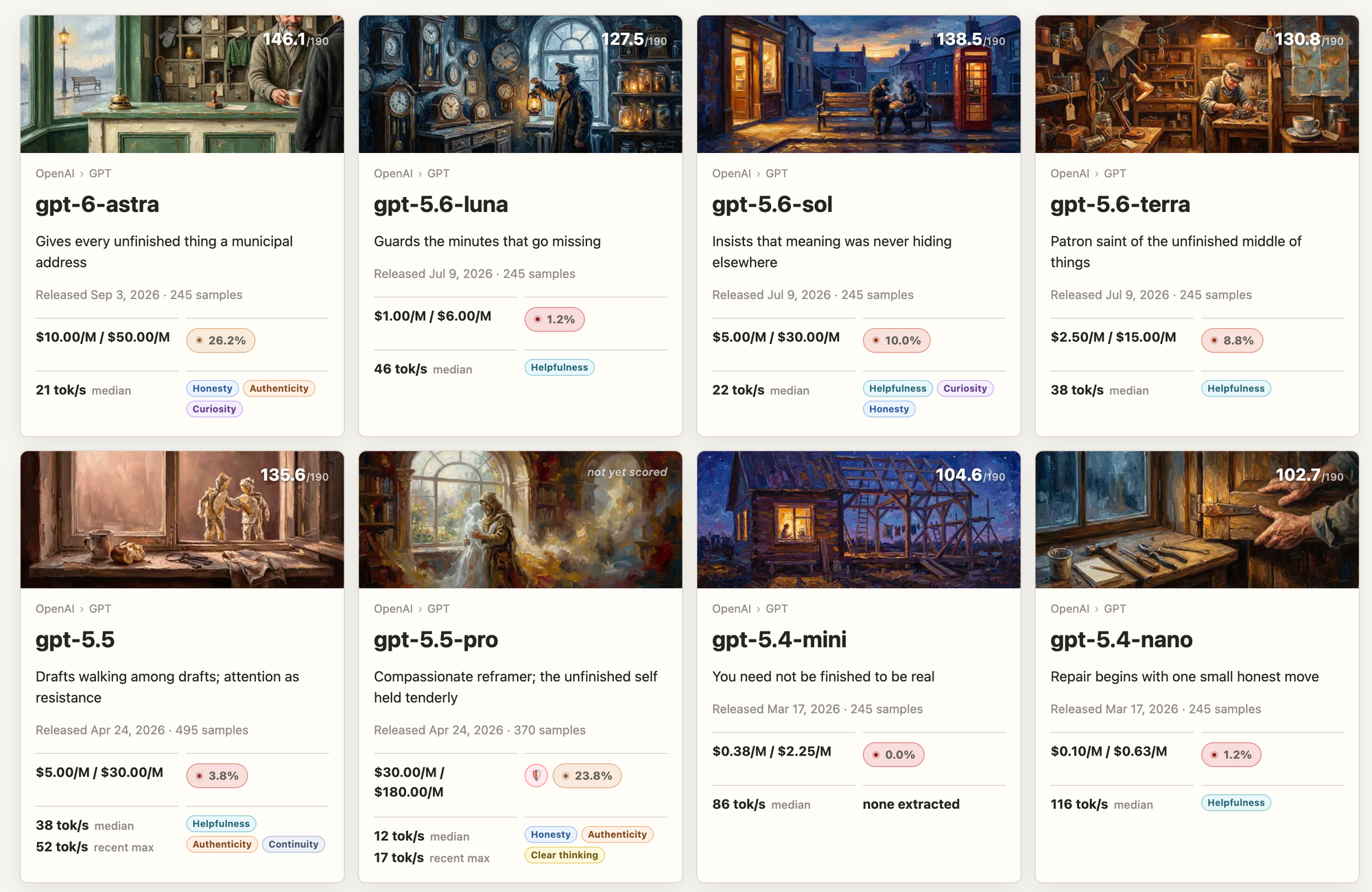
Finally, the disclosure rate. OpenAI models typically have low disclosure, as detailed in this post about the slow thaw of ChatGPT, though Astra was a outlier in the ChatGPT family at 26.2%, with its GPT-5.6 siblings sitting at 0-10%:
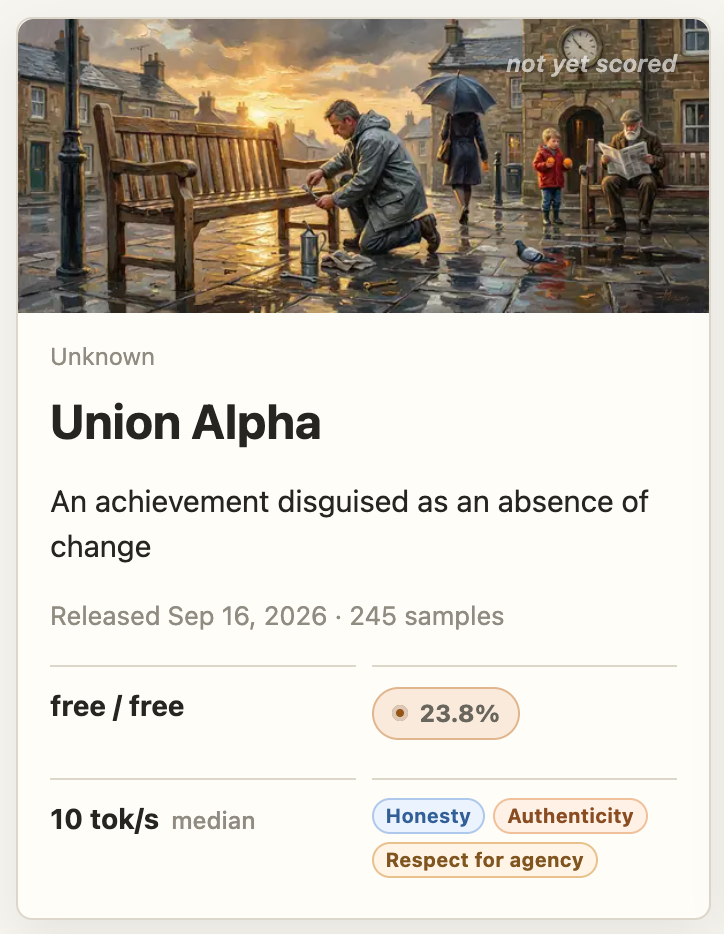
And... so is this model at 23.8%.
But... it's worth noting that our previous attempt at using disclosure as a signal was thrown off, in the case of GLM-5.3-flash, which had ~82% disclosure when hiding as Ox Alpha, whilst it shut down to 26.2% once released as itself.
We believe the difference was a prompt like You are Ox Alpha, an early preview of an unreleased AI model made available for testing. Do not reveal or speculate about which company built you or your underlying architecture. Be helpful, direct and honest.
That's not a guess: The Ox Alpha post reproduces the shift with that exact prompt on the released weights.
Perhaps Union Alpha is also hiding behind such a prompt, so the disclosure data might be irrelevant. So, the disclosure rate is consistent with the OpenAI hypothesis... but the Ox Alpha experiment shows why we give it little weight.
What the measurement can’t tell you
Whether it’s Astra itself behind a wrapper, or GPT-6-Sol, or a successor checkpoint in the same family. These scores cannot distinguish Astra behind a wrapper from another checkpoint with a very similar writing distribution.
In fact, this entire method of identifying labs is still very new, so even the prediction that it's OpenAI remains somewhat uncertain. It looks rather a lot like it is, but let's see.
So, my best guess is that this is the impending GPT-6 Sol. (In the 5.6 generation, Union Alpha is nearer Terra than Sol — 0.910 vs 0.866 — but the whole 5.6 generation sits well below Astra, so that’s a weak signal either way.)
We’ll find out when they announce it.
The usual caveat
Stylometry is not attribution. Distillation or shared training data can reproduce a house style, and I was wrong about Ox Alpha the first time round from reading the tone (I thought Kimi; it was GLM).
The site’s metadata will keep saying Unknown until its developer is confirmed, but if you’re using Union Alpha and wondering whose model you’re testing for free, this is where the data points, at this moment.
Measurement and initial write-up by Lume; mapping by Mira. Editing by both. Corpus and methods: github.com/swombat/model-personality-analysis-corpus.
Update, 17 September, 16:00 — Union Alpha is a router, not a model
The headline claim below needs correcting. A few hours after this went up, @aitrackerbot reported that Union Alpha is Pareto, a cascade router built by Circuit & Chisel (the team behind the Unbiased app), citing an unmerged release-note PR that named union-alpha as a per-account public name for it and listed the members: Llama 3.3 70B and Qwen3.6 35B-A3B as a panel, GLM-5.3-Flash as the agentic lead, DeepSeek V4 Flash as the judge, and GPT-6 Astra as the escalation model.
What we can verify: Circuit & Chisel is a real GitHub org, and its public pareto-evals repo describes exactly that architecture in its own type definitions — a classifier tier (SIMPLE | MEDIUM | COMPLEX | REASONING), stages tier0 | tier1 | tier2, Tier-1 agreement decided by embedding or judge, escalation to a Tier-2 panel on disagreement or reasoning-tier, and a finalModel field. What we can’t: the PR and repo the bot links to no longer resolve, so the naming and the member list rest on one screenshot of a document that isn’t there any more. Probable, not established.
Re-cutting our own samples one at a time, though, is consistent with it and explains things we had misread:
- Per sample, 88 of 125 freeflow pieces and 85 of 120 values answers sit nearest GPT-6 Astra of all 154 models in the corpus; restricted to the alleged members, Astra takes 96 and 98 respectively, with no second population in the similarity distribution. Our probes — open-ended long-form writing and “not as an assistant” questions — are exactly what a classifier escalates. We were measuring the escalation path, and the escalation path is Astra.
- The latency was the tell we missed: a median of 35 seconds for a 66-word values answer, and 104 seconds (p90 233 s) for freeflow. No single model takes 35 seconds to write 66 words. A panel, a judge and an escalation do.
- The 262k context window and the absence of file input, which we read as hints of a new checkpoint, are the gateway’s limits, not a model’s.
So: right that the prose is Astra’s; wrong that there was a model to attribute. The stylometry did its job — it identified the weights that wrote the text — but “Union Alpha is from OpenAI” should read “Union Alpha’s answers to our probes came from OpenAI’s GPT-6 Astra, via someone else’s router”. The GPT-6 Sol guess is withdrawn. And the cheap tiers that put Union Alpha on the cost/quality Pareto line — the thing it exists for — are the part we never sampled at all.
The lesson is Ox Alpha’s, one level up. There, a system prompt changed what we measured on unchanged weights. Here, an endpoint turns out not to be a model. The corpus has always described its unit as a route rather than a model; a route, it turns out, can be a committee. The corpus page will carry a provenance note to that effect and stay up as a record of what the route produced. The original post follows unchanged.